
How Suppression Works
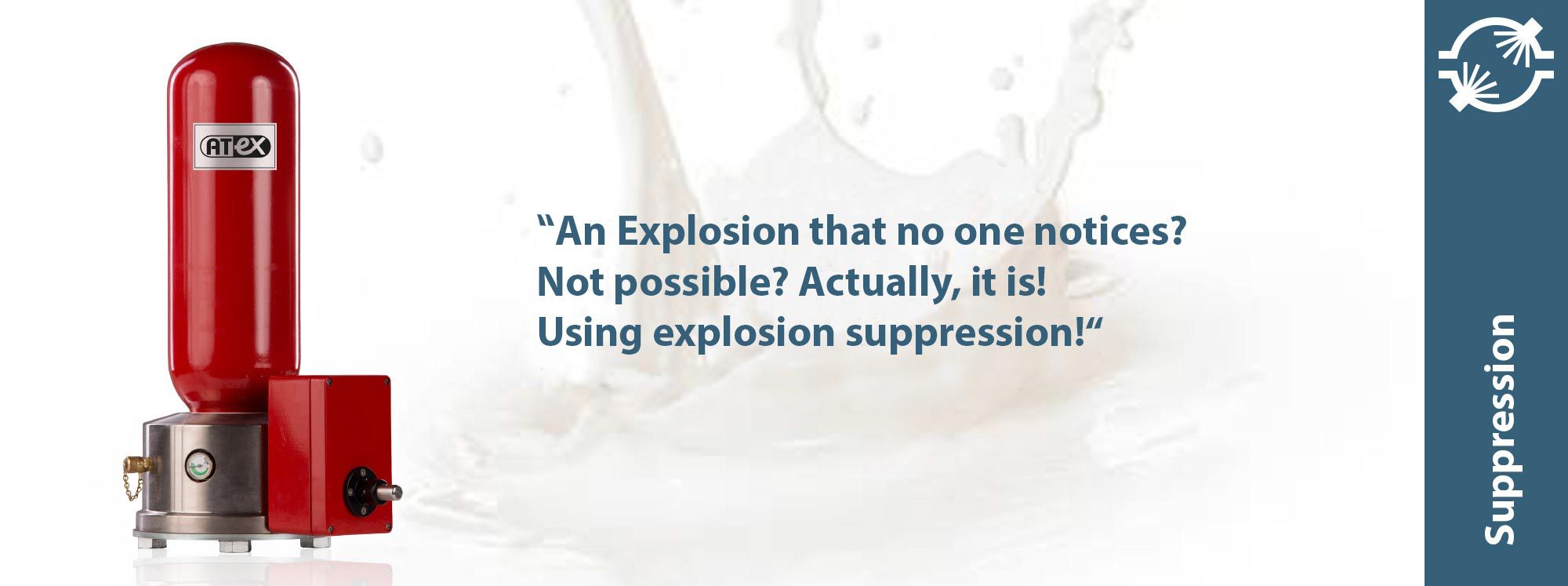
ATEX AIS (Advanced Inerting System) recognizes combustion at its earliest stage and rapidly discharges an appropriate extinguishant into the developing flame front, suppressing the explosion before pressure can damage the vessel.
- Detection: High-speed sensors recognize the ignition event and pressure or optical signatures.
- Activation: Gas generators instantaneously open the bottle via a proprietary, reusable leaf valve for high-rate discharge (HRD).
- Discharge: Extinguishant is delivered through application-specific nozzles to quench flame propagation inside the equipment.
- Control & Logging: exCONTROL / exCONNECT modules provide status display, relay outputs to the plant DCS, data logging, and on-device configuration.
Suppression Media Options
AIS-P (Powder)
Dry chemical suppressors inject powder directly into the explosion cloud to halt flame spread and limit pressure rise; the leaf valve design enables ultra-fast, repeatable opening.
AISH (Hot Water)
For applications requiring non-contaminating, large-volume suppression, ATEX’s hot water system releases superheated water that atomizes into fine droplets, creating an inert atmosphere and extinguishing the flame—your product only contacts water.
ATEX is the only manufacturer offering hot-water-based explosion suppression for facilities where cleanliness and product integrity are critical.
Nozzles & Hygienic Applications
ATEX supplies multiple nozzle systems to match process requirements, including hygienic designs for food, dairy, and pharmaceutical environments—ensuring the right coverage and cleanability for each vessel.
Controls, Monitoring & Integration
- exCONNECT relay module: Interface between explosion protection center and plant; relays key operating states; contact monitoring; LED status; local configuration; data download via built-in interfaces.
- System Safety: Mechanical sealing of bottles; permanent availability monitoring; SIL 2 design mandate for ATEX systems.
- Plant Integration: Relay contacts and signals for DCS/PLC, E-stop logic, interlocks, and shutdown actions as per your safety concept.
Where Suppression Fits
Suppression is ideal for process enclosures where venting is impractical or where flame and pressure must be contained inside the vessel (e.g., indoor equipment, product contamination concerns, limited discharge areas). ATEX provides integrated solutions across prevention, isolation, venting, and suppression.
Standards & Practices
- NFPA 69 — Standard on Explosion Prevention Systems.
- NFPA 652 — Fundamentals of Combustible Dust.
- ATEX/EN conformity for components in explosive atmospheres.
Canadian Division — Distribute & Install
ATEX Canada distributes and installs the full AIS range (powder and hot water), nozzle sets, bottles, control modules, and accessories across Canada—providing site surveys, calculations, installation, commissioning, and compliance documentation.
Technical Highlights
- High-rate discharge (HRD) via gas generator and leaf valve for rapid bottle opening.
- Mechanically sealed bottles with continuous condition monitoring.
- SIL 2 design philosophy for control and safety functions.
- Hot-water suppression option for non-contaminating protection in large volumes.
- Hygienic nozzle options for food and pharmaceutical processes.
Applications
- Spray dryers, fluid bed dryers, mixers, blenders
- Filters, cyclones, dust collectors, mills
- Silos, bins, and enclosed conveyors
Project Flow
- Site review & data: Process materials, vessel strength, geometry.
- System design: Sensor placement, bottle sizing, nozzle selection, controls integration.
- Install & commission: Functional testing, data logging, handover.
- Service: Periodic inspection, bottle condition checks, spare strategy.
Ready to Move Forward?
Let’s design the failure that never happens.